
As a member of the HSE’s Agricultural Industry Advisory Committee I have the somewhat dubious pleasure of receiving notification of all farm deaths. My heart sinks every time I see the email in my inbox. I most likely don’t know the victim, their family, or friends but it is still painful to be forced to think about what the deceased may have gone through and the suffering of all those closely involved.
In 2019-20 figures we saw positive steps with ‘only’ 21 killed in agriculture which was the lowest number in 5 years. However, the past year has been grim. Numbers have significantly increased, and the next set of published numbers may look bleak.
I think it’s hard in the current COVID-19 world to get our heads around the numbers. We need to be careful not to become immune and dispirited when we hear daily reports of hundreds of deaths. However, each statistic related as a farm death is a member of our community and the youngest in the last published figures was 4 years old. As an industry we cannot maintain our current record as being the deadliest industry. Workers in the agriculture, forestry and fishing sector are more than 20 times more likely to be killed at work than the average for all other sectors combined. Ironic when farming can be equally promoted by the media as being rustic and wholesome!
But where do we start to improve this depressing record?
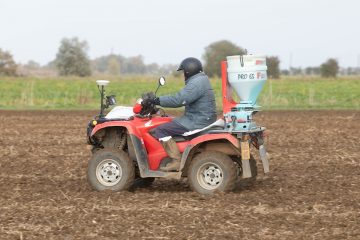
It seems we must go back to basics: change attitudes and make everyone stop and think twice before starting a task. Also, to question others who might be doing something we would consider risk-taking, such as why are you riding an ATV without a helmet; where is the PTO guard and why are there children unsupervised in the farmyard? Often difficult questions, but we should be aiming to make people think and then act out of social responsibility.
I have been criticised as the ‘fun police’ on social media for pointing out that perhaps it is not safe or legal to allow an unsupervised young child to drive a powerful forage harvester. It may be fun but only until I get the statistic in my inbox. We must make it socially unacceptable to take risks with lives.
I am proud to represent agricultural contractors at the NAAC, and I think we have an important role in keeping people safe in our businesses and on farms. The NAAC has long taken a proactive stance in promoting high standards of safety to its membership. We have a comprehensive Safety Management manual, which is included free of charge for our members, supported by an in-house consultant. Safety also features heavily in our Assured Land-Based Contractor Standard and the NAAC is a committed member of the Farm Safety Partnership.
I am fully aware that contractors rarely enjoy spending hours at a desk filling in paperwork, but members of the NAAC can save time and money by clicking through our online Safety Management Manual: it is easy to navigate, and the NAAC is on hand to help with any queries about how to personalise the manual. The NAAC Safety Consultant is also available to advise on the trickier aspects of safety management, giving free of charge first base advice to members. It is vital to take an integrated approach to safety so that all operations in the business are carefully thought through and ideally documented (even if having less than 5 employees). This helps to ensure that everyone is aware how to carry out tasks safely, covering the business if anything goes wrong and helping to prove that everything possible is being done to make safety a top priority.
The NAAC is certainly not here to criticise anyone that hasn’t yet got their safety procedures in place, but it is here to guide and help everyone get up-to-speed to allow contractors to sleep more soundly at night, secure in the knowledge that they are doing all they can to protect themselves, their workforce and clients.
The highest cause of fatalities in the past five years has been vehicles and, for contractors, that is our life blood. In the past year someone died when entangled in a PTO shaft, another died when crushed between his tractor and implement, another when the tractor ran him over. There were also three overturned tractors and additional ATV deaths.
I can’t give a complete list of safety guidance here, but accidents will be prevented if the hand brake is always applied, the engine switched off and key removed before working on, clearing or maintaining machinery. Never jump off a moving vehicle and always wear a helmet on an ATV. Simple advice but not always followed. Ensuring your safety policy and manual is in place is also essential to this, and NAAC is here to help members to get their paperwork sorted.
A fatality can have a massive financial impact on a business; it can result in a prosecution; it will take a huge emotional toll on those involved and leave a gap in someone’s family. Please don’t take the chance this could happen to your business.
Read more about the NAAC Safety Management Manual..
0 Comments